
- Category: Words Communication Tutorials
- Status: Complete
This video explores the ‘Manners’ and ‘People’ categories on the Words Communication Application I created for Lia and the relationship these categories have with one another in how they connect to the grammatical communication system to support role modeling aspects by linking manners to requests and directing both manners and requests to a person who can help with the requests that are being made by the student.
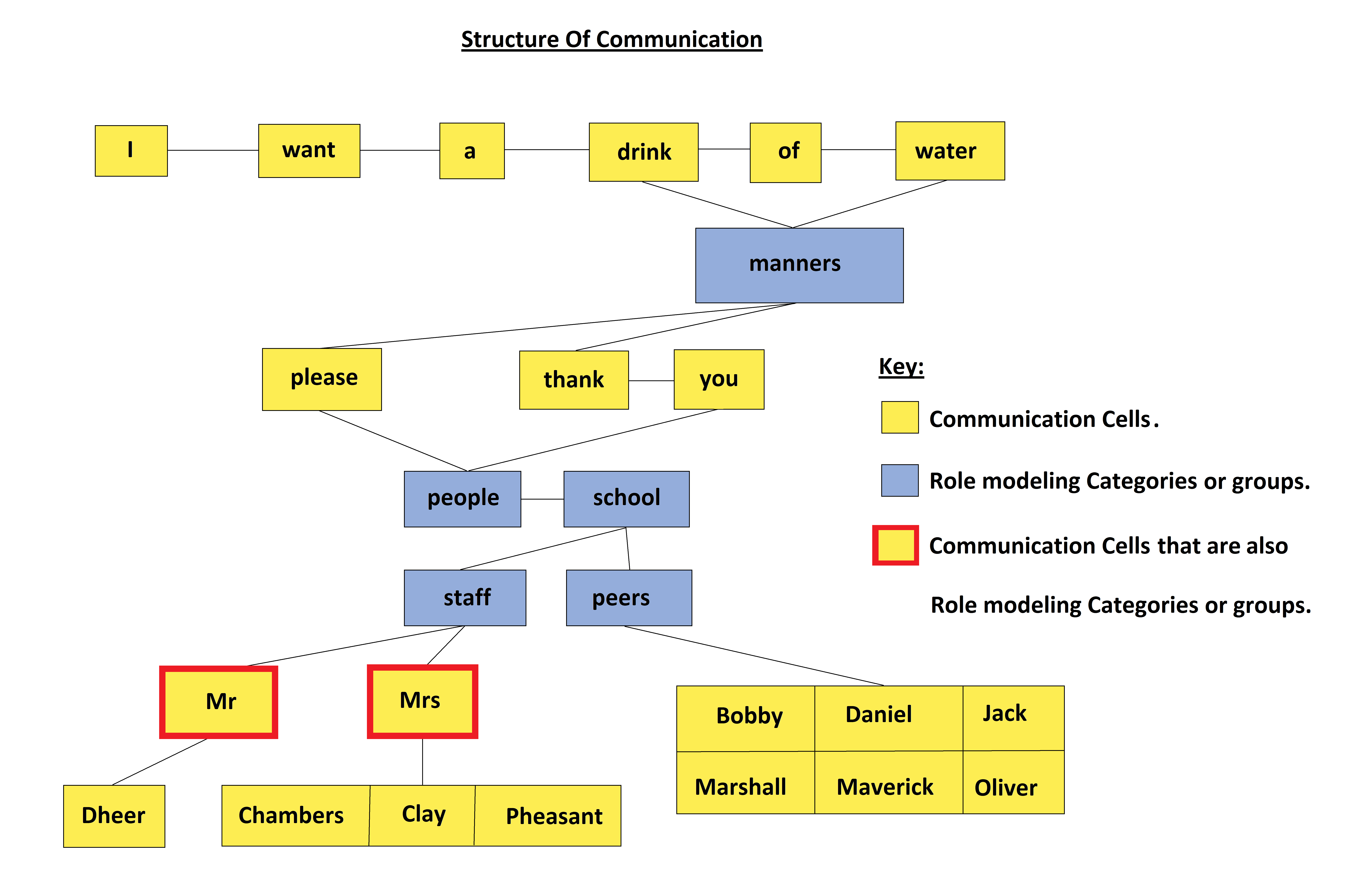
The above diagram is an example of the communication structure that shows how a sentence is constructed (using the yellow speaking cells that are assembled in sequential order onto the workspace as they are selected) and how these categories and groups are role modeled (using the blue cells which speak as they are selected but do not go into the workspace) with the end result displaying the completed sentence in the workspace which can then be broadcasted in its entirety when the ‘Speak’ button is pressed.
Role modeling works on two levels:
The First Level Of Role Modeling
The first level is the speaking categories or groups (blue categories/groups that provide important information that is spoken aloud so the student sees and learns this information without it filtering into the workspace). While these blue categories or groups are useful role modeling markers they are not information that would work in forming a completed sentence for example you would not say:
“I want a drink manners please”
You would instead say:
“I want a drink please”
Seeing and hearing the ‘manners’ group during the sentence construction is good for the purposes of role modeling, however when the sentence is completed and the ‘Speak’ button is pressed the sentence sounds both correct and meaningful by only displaying and speaking the relevant information about the request:
“I want a drink please”
This then teaches values during the sentence construction and correctness during the sentence vocalisation. Some of the speaking categories and groups are yellow cells (just like the regular speaking cells) yellow speaking category or group cells provide important information (just like the blue cells) but they also become a part of the completed sentence in the appropriate place during the sentence construction. The reason these categories or groups are yellow instead of blue and go into the workspace is because they are a relevant part of the completed sentence for example:
“Mr” or “Mrs”
Both of these choices are actually groups but they are also a relevant part of the sentence creation in that it is appropriate practice to use their group/categoric information before speaking a teachers surname for example:
“Mrs Pheasant”
Whereas it would be inappropriate and impolite to simply just say:
“Pheasant”
Additionally surnames used without the title first take on a whole new meaning such as the example above which demonstrates why some categories or groups are required to go into the workspace for the purpose of keeping the role modeling appropriate whereas others (the blue categories/groups) would not.
The Second Level Of Role Modeling
A second level of communication role modeling comes into play by offering relevant categories or groups of information in the appropriate place for the creation of a grammatical sentence such as the example below:
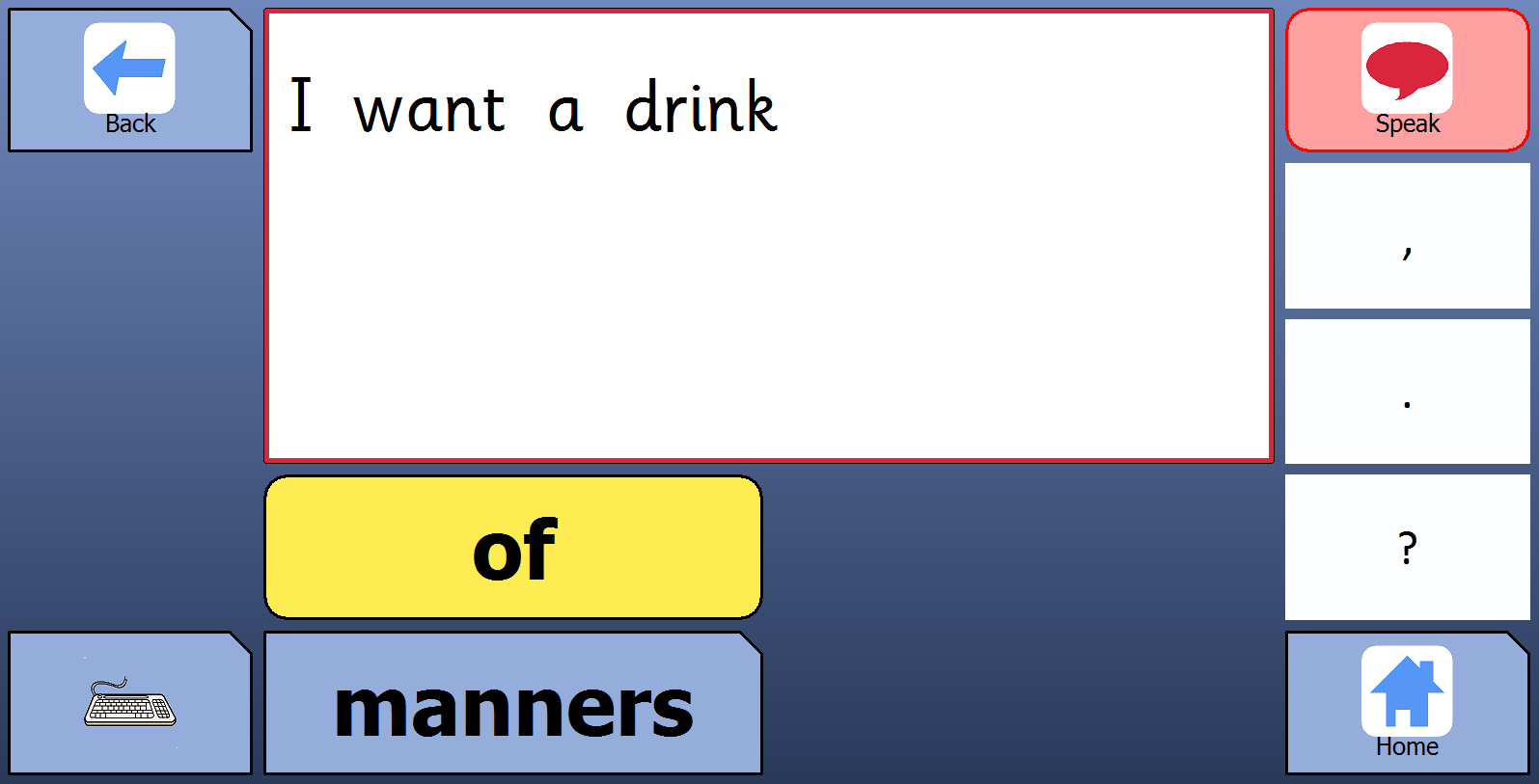
When the above sentence has been constructed the ‘manners’ group is offered so that the student can be polite in directing their request. As the student presses the ‘manners’ group it speaks “manners” so that the student hears this name; this then helps the student relate that information to the choices which they are about to make e.g. “please” or “thank you” and hearing that information over a period of time the student mentally categorizes it so that for example if they were to make a request without manners and the person receiving the request were to say to them “Manners” the student would then understand this prompt and either press the words “please” or “thank you” sequentially depending on which would be appropriate for either asking or receiving the request they had just made. After ‘Manners’ have been used the ‘People’ category is offered so that the student may personalize their request by using the names of the people they are directing their request too. Naturally there are a number of categories and subcategories in the ‘People’ category that additionally role model information so that the student becomes familiar with various groups of people and the type of relationship they have with those people from a personal or professional point of view.
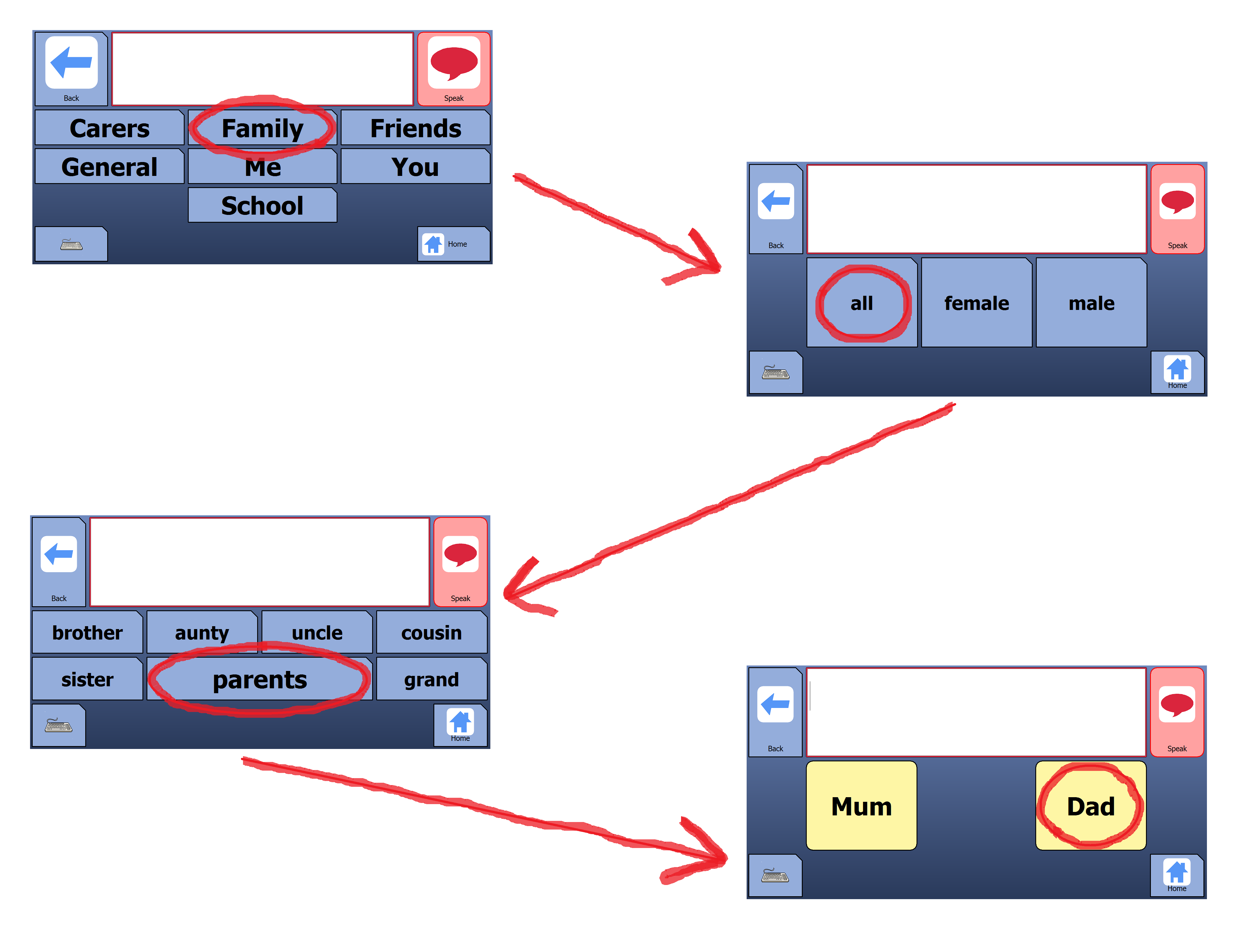
These categories, their subcategories and groups not only role modeling this information by speaking it as they are selected but they also break down large lumps of data (that otherwise would create a visual overload of choices for the student) into smaller more manageable amounts of information that is far more digestible and easier for the student to work with. Over a period of time these role modeling categories raise the students awareness about the people in their lives which teaches them the understanding that those people all belong to a specific set of categories, subcategories and groups for example:
Categories/Subcategories/Groups/Group and Choice/Choices
People/Family/Parents/Dad or Mum
People/Family/Sister/Mia
People/School/Peers/Bobby, Daniel, Jack, Marshall and Oliver
People/School/Staff/Mr/Dheer
People/School/Staff/Mrs/Chambers, Clay or Pheasant
People/Carers/APTCOO/Paula, Tracey or Tash
People/Carers/Sue’s Family/Ellie, John or Sue
While on first look this may just seem like a reasonable way to present this type of information after a deeper examination over a period of time it has proven its worth by raising awareness in the students long term understanding which increases every time the student chooses a persons name for example like choosing ‘Dad’ because they are also hearing and seeing the other information which they are first required to navigate through ‘People’, ‘Family’ and ‘Parents’ which in turn role models the understanding in that whenever the student hears the word “Parents” spoken by other people they are then able to remember the information relevant to the categorized groups and choices they have followed (which leads them to ‘Dad’ and ‘Mum’) so the student then becomes aware (in Lia’s case) and understands that ‘Dad’ and ‘Mum’ are ‘grouped’ as ‘parents’ and that ‘Mia’ for example would be ‘grouped’ as her ‘sister’ and also that all of these three people are ‘categorized’ as ‘family’.
To put this detail into a basic perspective; the value of this information in the short term learning is about people, the categories, subcategories and groups of which they all belong in the relationship of connecting them to the requests and information that is being made or presented by the student. Whereas the long term learning is a role modeling experience that teaches the understanding of who people are and their relevance to the relationships within the lifestyle of the student.
© AORPETE LEARNING
 myautismresources.com